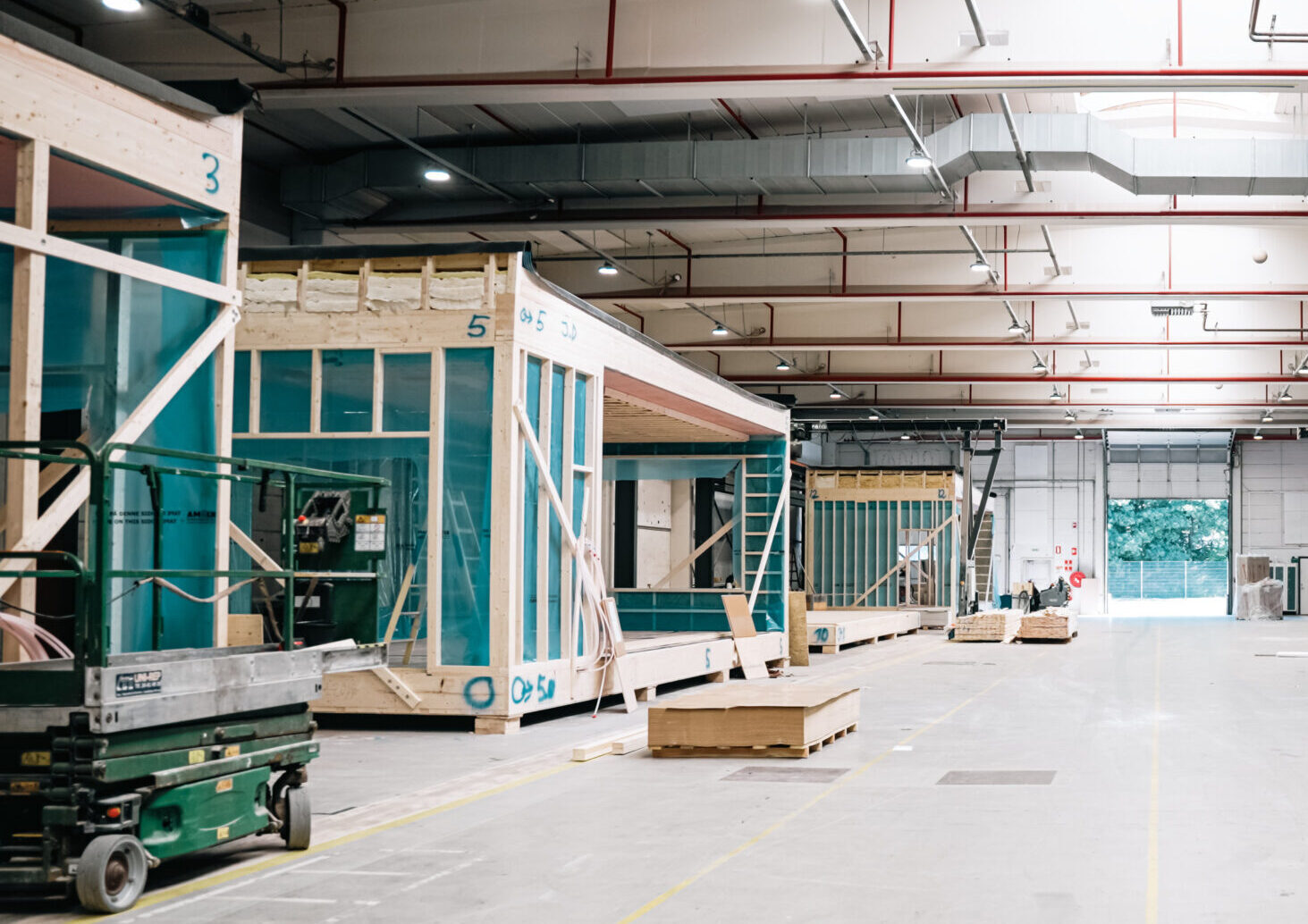
We build according to Design for Disassembly

A principle that enables responsible construction

Some buildings are made to stand until one day they are demolished. Others are designed with a longer-term perspective from the outset.

At ABC Pavilloner, circularity is a fundamental part of how we build. We reuse as large a share of our building materials and components as possible and incorporate them into new contexts until they are worn out.

That is why we build according to the principle of Design for Disassembly.

What does that mean in practice?

Design for disassembly means that we design and construct buildings so they can easily be taken apart when their justification or purpose has come to an end. Structures, joints, and materials are chosen so modules can be moved, modified, and reused as needs change.

For you, that means a building designed to be adaptable and retain its value over time.

We see this as a concrete and logical way to work with circularity.

Construction that can be reused

Our rental modules are already part of a circular cycle: sections, modules and sometimes entire buildings are dismantled, refurbished and reused in new projects.

The same principle applies to our sister company’s permanent construction. When a building has one day fulfilled its purpose, it is designed so that it can easily be disassembled, sorted and, to the greatest extent possible, reused.

It’s not temporary—it’s well-thought-out construction.

A responsibility that goes further

We work from the principle that it should be easy for those who come after us to deal with the buildings we put up today. Materials must be easy to dismantle. They must be sortable. And as many of them as possible should be reusable where it makes sense.

For you, that means a building project that not only meets a current need, but is also conceived in a broader context—showing respect for resources, finances, and the future.

For us, Design for Disassembly is not a detail in the process. It is the way we think about construction: from the first line and for many years to come.

Would you like to learn more about Design for Disassembly?

Scroll to Top